Taxonomy is a underlying mesh of information particles keeping the organization information space together.
- It gives both the structure and naming of structure elements.
- It is the essential common language of the organization
The Core
Taxonomy shape is a two-level hierarchy.
- Categories — the four first-level nodes
- Capabilities — the four second-level nodes within each Category
The definitive hierarchy and terminology are maintained in taxonomy_core.md. This document explains the taxonomy — it does not redefine its core.
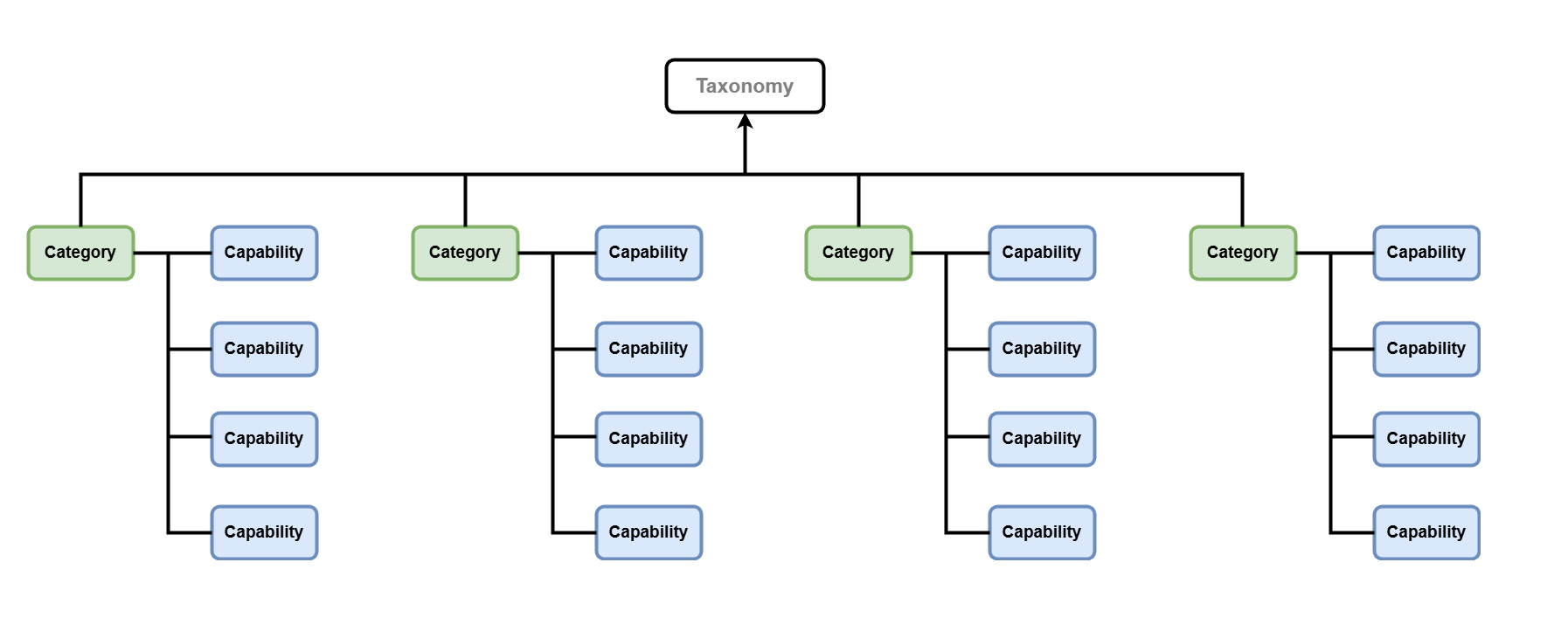
Enterprise Taxonomy
What is a Enterprise Taxonomy?
Enterprise Taxonomy is a hierarchical classification structure for an commercial enterprise (aka organization) information space. It serves as:
- A positioning system — locating any concern within the organization’s information space
- A communication aid — providing shared vocabulary across disciplines and roles
- A governance foundation — enabling consistent cataloguing, discovery, and reuse of knowledge
The Enterprise Taxonomy applies this concept to the Enterprise Domain. Its terminology is technology-neutral and applicable across business activities, roles, and deliverables.
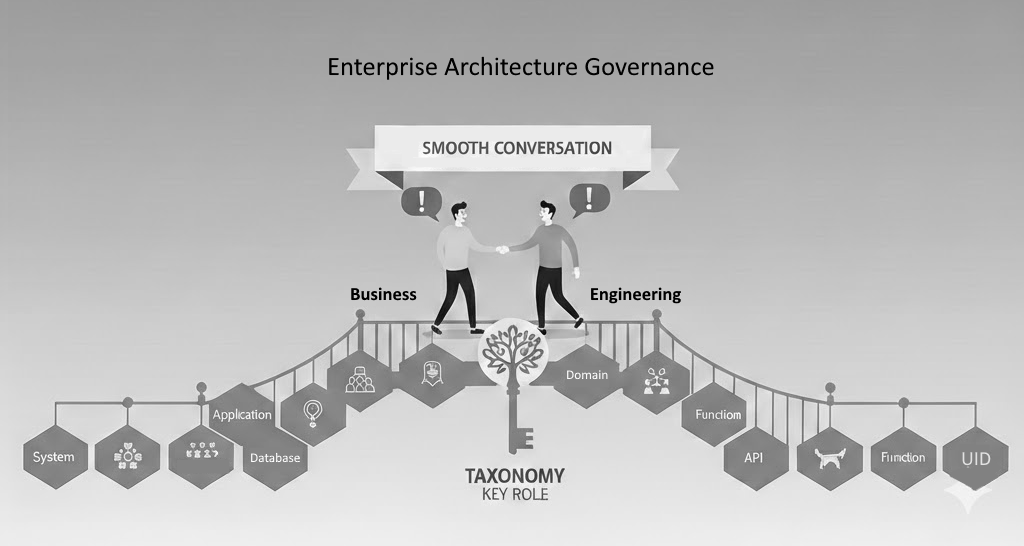
Enterprise Taxonomy is a key communication asset of the Enterprise
Enterprise Taxonomy Terminology
Each Category together with its Capabilities forms a complete category definition. The four Categories are ordered by level of abstraction, from highest on the top to lowest on the bottom.
Root of the hierarchy tree is thus top-left positioned.
Category: Conceptual
High-level blueprint: business goals, information domains, application functions, and technology choices. Establishes alignment with business objectives and shared understanding among stakeholders.
Capabilities
- Business — Business goals and objectives; alignment of systems with organizational strategy and desired outcomes.
- Information — Data structures and relationships the organization needs; how information is organized to serve business processes.
- Application — Functions and features delivered to users: interfaces, processing, reporting.
- Technology — Underlying technologies selected to build and operate systems: languages, databases, platforms.
Category: Logical
Detailed design: how components interact, how data is managed, how systems integrate, and how they are secured. Bridges conceptual intent and physical reality.
Capabilities
- Data Management — How data is stored, accessed, and governed across systems.
- Integration — How systems communicate and exchange information with each other.
- Platform — The software environment and runtime infrastructure on which systems operate.
- Security — Measures protecting systems and data from unauthorized access and threats; compliance with standards.
Category: Physical
Tangible resources: hardware, infrastructure, connectivity, and storage. Ensures a stable, scalable environment for reliable processing and data exchange.
Capabilities
- Compute — Processing resources: servers, processors, virtual machines.
- Infrastructure — Physical and virtual environment: data centres, hosting, environmental support.
- Network — Communication pathways connecting components and users.
- Storage — Devices and strategies for persisting and retrieving data.
Category: Implementation
Processes and practices for building, delivering, and sustaining systems. The lower in the taxonomy, the more engineering roles participate — but architectural decisions on structure and boundaries remain at every level.
Capabilities
- Deployment — Installing and configuring systems in target environments; transition from development to production.
- Development — Designing, coding, and testing; transforming requirements into working systems.
- Monitoring — Tracking performance and health after deployment; identifying and resolving issues.
- Operations — Ongoing management: updates, backups, incident response, and continuous improvement.
Capabilities
In the context of Enteprise Taxonomy, Cabilities have two facets.
Quick Definitions of two facets of capabilities
Taxonomy Capability (Structural): a named classification node — fixed, structural, defined by taxonomy_core.md.
Organizational Capability: the measurable ability to staff and execute within that node — variable, evolving, and the basis for enterprise KPIs.
Capability as Taxonomy Term
The taxonomy defines sixteen Structural Capabilities — the named second-level nodes within each Taxonomy Category. These are structural: they name what matters in the organization’s information space. They do not change with staffing, maturity, or time.
Capability as Organizational Ability
An organization develops and maintains its actual capability within each of those named slots. This is measurable: can the organization staff, execute, and deliver within a given Capability?
The taxonomy names sixteen Capabilities. The organization’s maturity is reflected in how effectively it performs across them. These are the enterprise KPIs (Key Performance Indicators).
Roles and Actors
Each staff member holds a Role — such as Product Owner, Enterprise Architect, Business Analyst, or Stakeholder. Role names are organizational; they do not mirror Capability names. A group of Actors (staff members sharing a Role) collectively own the organization’s ability to perform within one or more Capabilities.
Actors are not always humans. At different levels of abstraction — or from different Points of View (POV) — an Actor may be a system, a service, or an automated process.
Example: An Enterprise Architect and a Business Analyst both operate within the “Business” Capability of the “Conceptual” Category — one defines the structure, the other elaborates the requirements. The Role names differ; the Capability they serve is the same.
Analogy: Your village library
Might be your favorite place. Trusty librarian at the front desk is always helpful and able to quickly find the book you need. That is us the use case proving the taxonomy necessity.
- you and librarian have been able to has a short conversation on what you need. Without knowing the exact book.
- she was able to quickly find a book you both agreed on.
- the plan of the library itself was made to accommodate books and commute inside the storage so that librarian can easily find the single book among many
How has taxonomy enabled that?
- Shared vocabulary — you and the librarian both use the same words for the same shelves. Neither of you invents new terms mid-conversation.
- This is the Taxonomy as common language: Categories and Capabilities are named once, organization-wide, with no local reinterpretation.
- A known structure to search within — the librarian doesn’t scan every shelf; she narrows by section, then by aisle, then by shelf.
- This is the Taxonomy as hierarchy: Category → Capability gives a fixed, shallow path to any point in the space.
- The library layout was fixed before the books arrived — the library’s layout doesn’t get redesigned every time a new book comes in.
- This is the Taxonomy as structure independent of content: the slots are stable; what fills them (staffing, maturity, actual work) changes constantly.
- You didn’t need to know the exact book — a rough description was enough, because the structure narrowed the search space for you.
- This is the Taxonomy doing its job before any conversation starts: it makes “roughly what you mean” resolvable to “exactly where that lives.”