This document is single source of truth. It contains the taxonomy hierarchy and the terminology defined by it. These definitions are to be used company wide, with no changes or reinterpretations. Ideally industry wide
- Common, shared and simple Taxonomy is the underlying essential mesh holding the IT organization operations together.
- It gives both the structure and naming of structure elements.
- It is the essential common language of the organization
The Schema
Schema is data description. Data about the data aka “meta data”. Schema will be required by tools operating on the DBJ Taxonomy. “schema” is not the Taxonomy itself. Taxonomy Schema is made of only two elements. DBJ Taxonomy is hierarchy. This schema definition is visual. First level are categories, second level are capabilities.
├── Category
│   ├── Capability
│   ├── Capability
│   ├── Capability
│   └── Capability
├── Category
│   ├── Capability
│   ├── Capability
│   ├── Capability
│   └── Capability
├── Category
│   ├── Capability
│   ├── Capability
│   ├── Capability
│   └── Capability
└── Category
    ├── Capability
    ├── Capability
    ├── Capability
    └── Capability
- Category
- Top level classification. Only four Categories total.
- We divide the whole operational space of the IT based company in these four categories.
- In schema we do not say what are they, we just define there is four of them
- Capability
- Each Category has total four offspring nodes: Capabilities. That makes 16 Capabilities, all together
- We just define there is four of them per each category.
Taxonomy entities are uniquely defined by two schema elements: Category and Capability.
DBJ Core Taxonomy
Schema elements are given concrete names to define the DBJ Taxonomy in the context of an commercial enterprise based on IT.
├── Conceptual
│   ├── Business
│   ├── Information
│   ├── Application
│   └── Technology
├── Logical
│   ├── Data Management
│   ├── Integration
│   ├── Platform
│   └── Security
├── Physical
│   ├── Compute
│   ├── Infrastructure
│   ├── Network
│   └── Storage
└── Implementation
    ├── Deployment
    ├── Development
    ├── Monitoring
    └── Operations
First level are named categories, second level are named capabilities. From the schema we know this is hierarchical arrangement.
Vocabulary/Terminology are official words. Please do not use synonyms. That will dilute their unique meaning defined by the taxonomy.
IPS of the Info Space#
Taxonomy might be explained as the terminology of the Information Space Positioning System (ISPS). Example Taxonomy Plaque:
Category: Implementation
Capability: Development
The vocabulary on that plaque is small, rigid and well defined. And immediately understood
With this plaque on the content, both consumers and producers of the content know what the tagged content is all about. And the author does not need to explain it to every reader.
Think plaque on the Shipping Container.
Lineage
Where is this coming from? Beside good old “abstract to concrete” philosophy, DBJ Taxonomy relates to the DBJ ADM (mapped onto the TOGAF ADM)
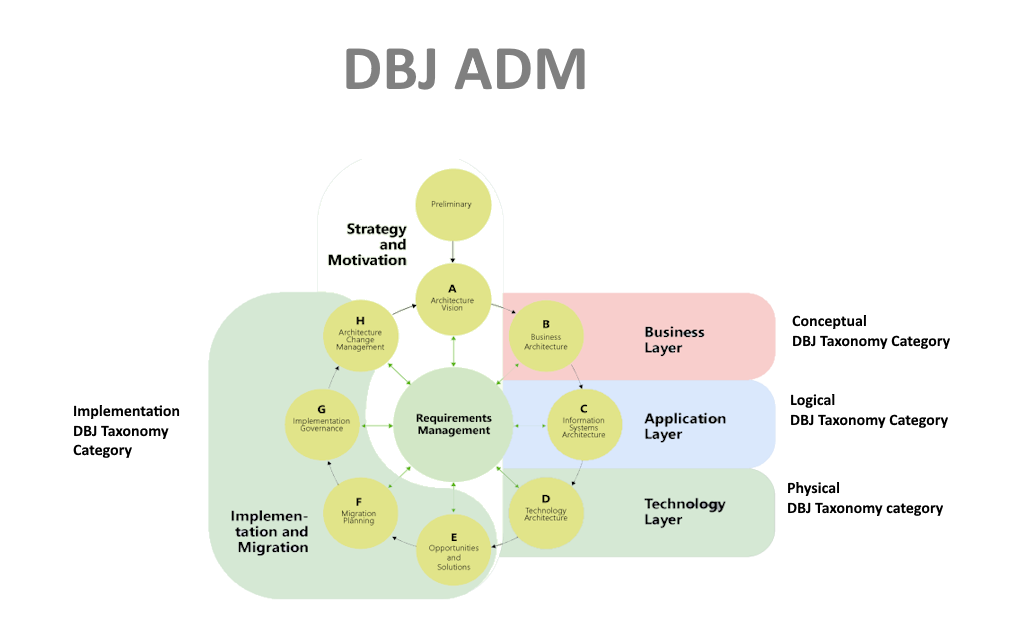
DBJ Taxonomy and DBJ ADM give meaning to each other in the context of business development.
Vocabulary
Information Space Positioning System (ISPS)
The organization’s information space is a space in the literal sense: content sits somewhere in it, and without coordinates nobody can say where. The Taxonomy supplies those coordinates. Category and Capability are the two axes; together they fix a position.
A Taxonomy Plaque is a position expressed on a piece of content — the equivalent of a coordinate reading. It states where the content sits, not what it says.
The analogy to satellite positioning is deliberate and bounded: a small fixed vocabulary, applied uniformly, yields an unambiguous position for anything within the space. It does not imply navigation, distance, or movement between positions.
Schema
The shape of the hierarchy, independent of the names on its nodes. It fixes the depth (two levels), the arity (four by four), and the two element kinds — Category and Capability — but says nothing about what any node is called.
The schema is the invariant. The DBJ Core Taxonomy is one naming of it, for the context of a commercial enterprise based on IT.
The “abstract to concrete” progression
Traces to Aristotle’s Metaphysics and Posterior Analytics — the idea that genuine knowledge (episteme) moves from universals (genus, form) down to particulars. Aristotle’s hierarchy of genus → species → individual is the direct ancestor of every taxonomic tree since.
Including Porphyry’s Tree (3rd century AD, Porphyry’s commentary on Aristotle’s Categories) — a top-down branching hierarchy from substance down to individual, structurally identical.
Commercial Organization In the Global Info Space
The Ideal Scope of the Taxonomy
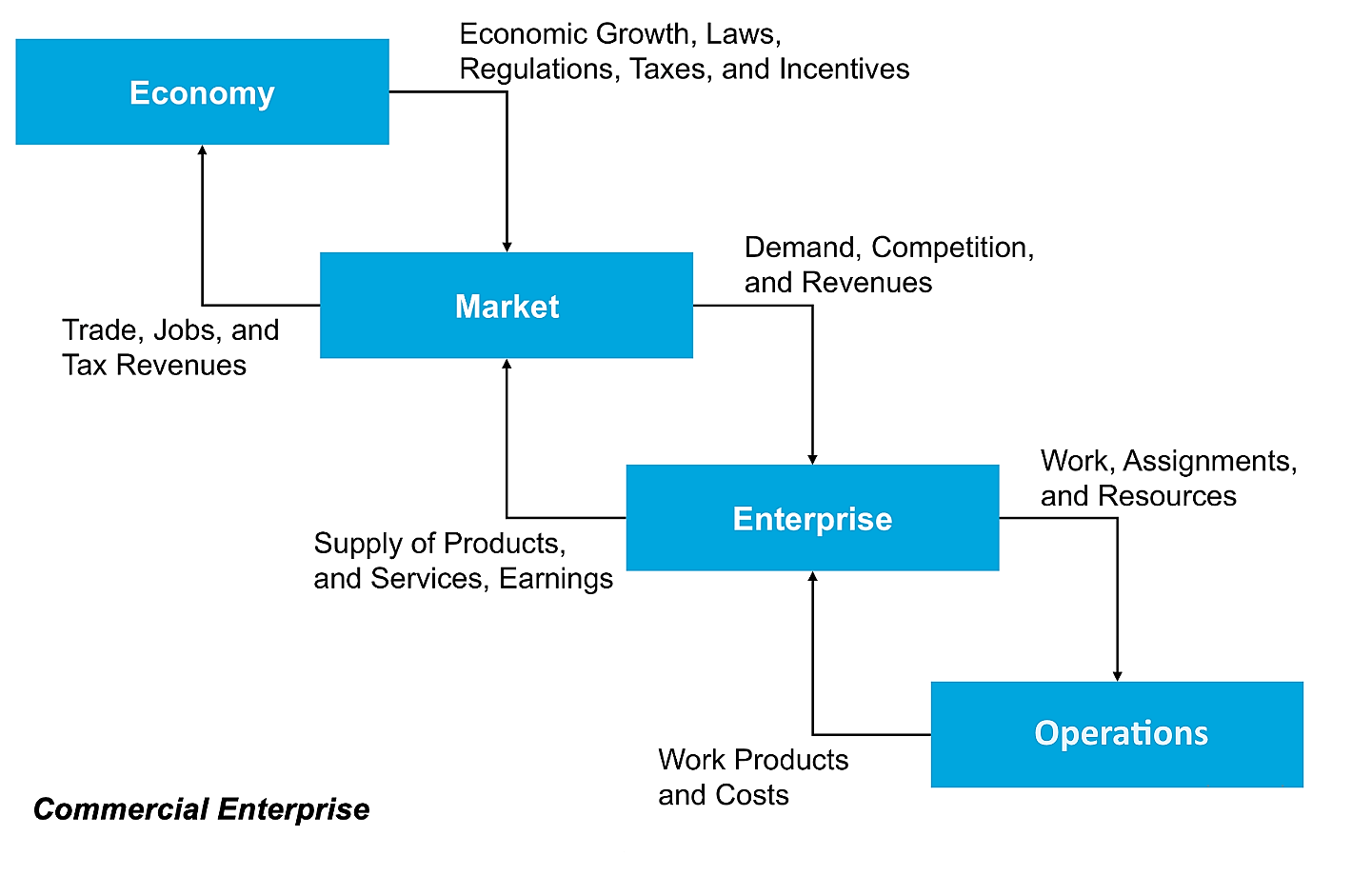
- Initial scope of this taxonomy is internal to the Commercial Organization In the Global Info Space.
- Common language of IT Landscape classification on the level of organization
- Ideal scope is Industry Wide.
- DBJ Taxonomy would be best utilized ad the common language axioms, on the level of the industry