ITIL and TOGAF
Audience: Enterprise Architecture Practice
Purpose: Establish ITIL as the benchmarking and standards measurement framework for IT operations; clarify its boundary with TOGAF
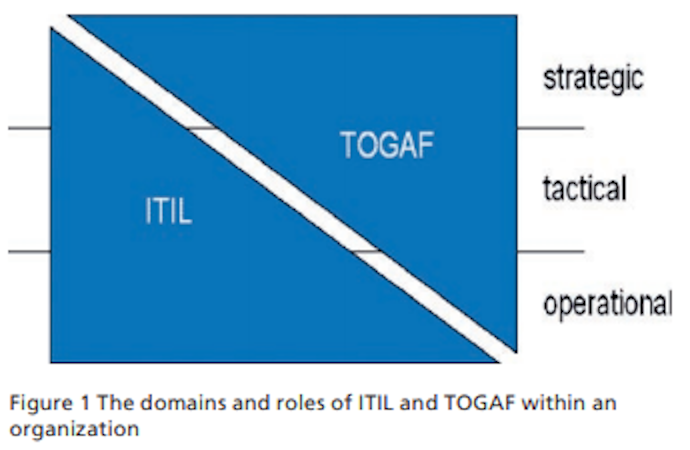
Framework Boundary Clarification
| Concern | Framework | Scope |
|---|---|---|
| Architecture design and transformation | TOGAF / ADM | How to change |
| IT service quality and operational benchmarking | ITIL | How well you run |
What ITIL Provides
ITIL (IT Infrastructure Library) is a globally recognised framework for IT Service Management (ITSM). The current version, ITIL 4, is structured around the Service Value System (SVS) — a model that ensures all components of an organisation work together to create value through IT-enabled services.
Key constructs relevant to benchmarking:
Service Value Chain (SVC) — six activities (Plan, Improve, Engage, Design & Transition, Obtain/Build, Deliver & Support) that map IT activities to business value delivery. Each activity is a measurement point.
Four Dimensions — People & Organisation, Information & Technology, Partners & Suppliers, Value Streams & Processes. These are the lens through which IT landscape health is assessed, directly aligned to EA concerns around capability and dependency mapping.
34 Management Practices — grouped into General, Service, and Technical practices. The most operationally critical for benchmarking are:
- Incident Management — MTTR, incident volume, SLA breach rate
- Problem Management — recurring incident rate, known error backlog
- Change Enablement — change success rate, failed change ratio, emergency change frequency
- Service Level Management — SLA/OLA compliance, service availability
- Availability Management — uptime percentage, MTBF, MTRS
- Capacity & Performance Management — resource utilisation vs. demand forecast
- Continual Improvement — improvement initiative throughput, backlog age
Key Benchmarking Metrics by Domain
Service Reliability
- Availability: target ≥ 99.5% for Tier 1 services
- MTBF (Mean Time Between Failures): trending upward = improving
- MTRS (Mean Time to Restore Service): target aligned to business RTO
Change Quality
- Change success rate: industry benchmark ≥ 95%
- Emergency change ratio: should be < 5% of total changes
- Failed changes causing incidents: target < 2%
Incident & Problem
- P1/P2 incident frequency: absolute volume and trend
- Repeat incidents (no permanent fix): indicator of problem management debt
- SLA breach rate: per service tier
Service Desk
- First Contact Resolution (FCR): benchmark 70–80%
- Ticket backlog age: no ticket > agreed SLA breach threshold
Continual Improvement
- Open improvement items vs. closed per quarter
- Time-to-implement approved improvements
Integration with EA Practice
The EA team might use ITIL metrics as input signals to the Architecture Development Method (ADM):
- Phase A (Architecture Vision): ITIL baseline metrics define current-state pain points
- Phase B/C/D (Business/IS/Technology Architecture): SLA and availability targets inform NFRs in target architecture
- Phase E/F (Migration Planning): Change success rate and MTRS inform sequencing and risk assessment
- Phase G (Implementation Governance): ITIL change enablement gates align with architecture compliance checkpoints
- Phase H (Change Management): Continual improvement metrics feed architecture refresh triggers
Maturity Baseline (ITIL CMM Alignment)
ITIL 4 does not prescribe a formal maturity model, but the EA practice should adopt a 5-level maturity scale against each management practice:
| Level | Description | |—| | 1 — Initial | Ad hoc; no defined process | | 2 — Managed | Process defined but inconsistently applied | | 3 — Defined | Standardised, documented, measured | | 4 — Quantitatively Managed | Metrics-driven; SLAs enforced | | 5 — Optimising | Continual improvement embedded; predictive capability |
Target for consolidated IT landscape: Level 3 minimum across all Tier 1 service practices before any significant architecture transformation is initiated. Level 4 for Incident, Change, and Availability management.
Potential Next Steps
- Conduct ITIL practice maturity assessment against current IT landscape
- Define service tiers (Tier 1/2/3) aligned to business criticality — EA input required
- Establish baseline metrics for the 7 priority practices listed above
- Set target benchmarks per tier; publish as EA-governed IT Standards Register
- Integrate ITIL reporting cadence into Architecture Review Board agenda
Document owner: Enterprise Architecture Practice
Framework references: ITIL 4 Foundation (AXELOS), TOGAF 10 (The Open Group), DBJ ADM