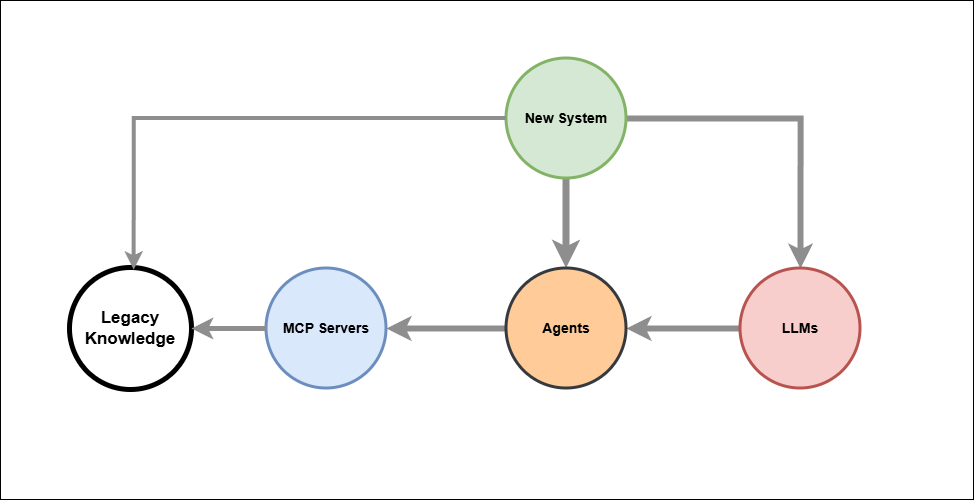
Pattern: New System → Agents → MCP Servers → Legacy Knowledge
The diagram describes a clean integration architecture for connecting new AI-enabled systems to existing enterprise knowledge.
Agents are the central orchestration node. The New System may reach them directly — for deterministic, rule-based, or high-volume operations — or via LLMs, where natural language interpretation or dynamic reasoning is required. The choice of path is made by the New System, not by the LLM.
LLMs are a peer input to Agents, not the architectural gateway. They handle ambiguous intent, natural language from human actors, and dynamic tool selection. For scheduled, transactional, or audit-critical operations, the New System bypasses the LLM entirely and calls Agents directly.
MCP Servers are the integration boundary. They expose legacy capabilities as typed, named tools, translating Agent requests into API or database calls against the Legacy Knowledge store. The knowledge never moves — it remains authoritative in its source system.
A direct path from New System to Legacy Knowledge is preserved for operations that must bypass both LLM and Agent layers entirely.
Key Principles
- Agents own orchestration — independently callable, containerised, API-exposed
- LLM is one consumer of Agent capability, not its owner
- New System chooses the appropriate path based on operation type
- Legacy Knowledge stays in place — single source of truth
- Security and audit boundaries apply at every entry point to Agents and MCP Servers
- Agents are independently testable without an LLM in the loop
The reality of any enterprise legacy landscape.
“Legacy Knowledge” as a single cylinder is a simplification. In practice it is:
Relational DBs (Oracle, SQL Server, MySQL)
Document stores (SharePoint, file shares, email archives)
Flat files (CSV, XML, EDI, mainframe VSAM)
ERP/CRM internal DBs (SAP, Dynamics — opaque schemas)
Data warehouses / data marts
Message queues / event logs
Paper-scanned PDFs (OCR territory)
The architectural implication:
MCP Servers must handle this incoherence. Each MCP Server is effectively an adapter — one per data source type or system, normalising access behind a consistent tool interface.
Agent → MCP Server (SAP adapter)     → SAP DB
Agent → MCP Server (SQL adapter)     → RDBMS
Agent → MCP Server (document search) → SharePoint / file store
Agent → MCP Server (OCR/RAG)         → Scanned docs / PDFs
This is why MCP Servers are plural in the diagram — and why that matters. The Agent does not need to know the physical storage topology. It calls named tools. MCP Servers carry the adapter complexity.
MCP Servers are a critical decoupling
That is the precise EA statement
MCP Servers decouple:
FromToAgent (consumer)     vs Physical storage topology
Tool interface (stable)    vs Adapter implementation (volatile)
Business capability        vs Data source technology
This is the classic Anti-Corruption Layer from DDD, or the Translation Layer in TOGAF terms — applied at the data access boundary.
The consumer (Agent) is shielded from:
- Storage heterogeneity
- Schema changes
- System migrations
- Legacy system replacement
Practical consequence: You can replace an Oracle DB with a document store behind an MCP Server and the Agent never knows. The tool contract is the only interface that matters.
This also means MCP Servers are where data governance, access control, and audit logging are enforced — consistently, regardless of what sits behind them.