The pull of the AI force
You used to change one thing at a time. But suddenly that is a luxury. At AI speed, you need to change five things at once, and admittedly you don’t get five solutions to five problems: you get a mess.
You know that was always the trap in all the complex systems. Touch the app, the servers, the logins, the deployment, the data, and the monitoring: all at once. And when something breaks, nobody can tell what is broken.
You have these expensive advices, you paid for once: “…keep what already works…”, or: “Don’t touch it. Put your effort only where you’re genuinely figuring something out for the first time”. What that even means in the context of your business?
Our comment: keep fewer things changing at once. Spend your budget where it actually makes the product better, not on redoing things that already worked.
But how do you do anything when AI is slamming at the door?
James L. Pulley: “Unknowns do not add. They multiply.”
Business value proposition?
You have probably heard “digital transformation” enough times to wince at it. You watched the AI demo work, and asked six months later where the return went. Someone showed you a roadmap once. You do not trust roadmaps anymore.
Well here is what we use instead of roadmap. And it always works.
The iceberg of pride and prejudice.
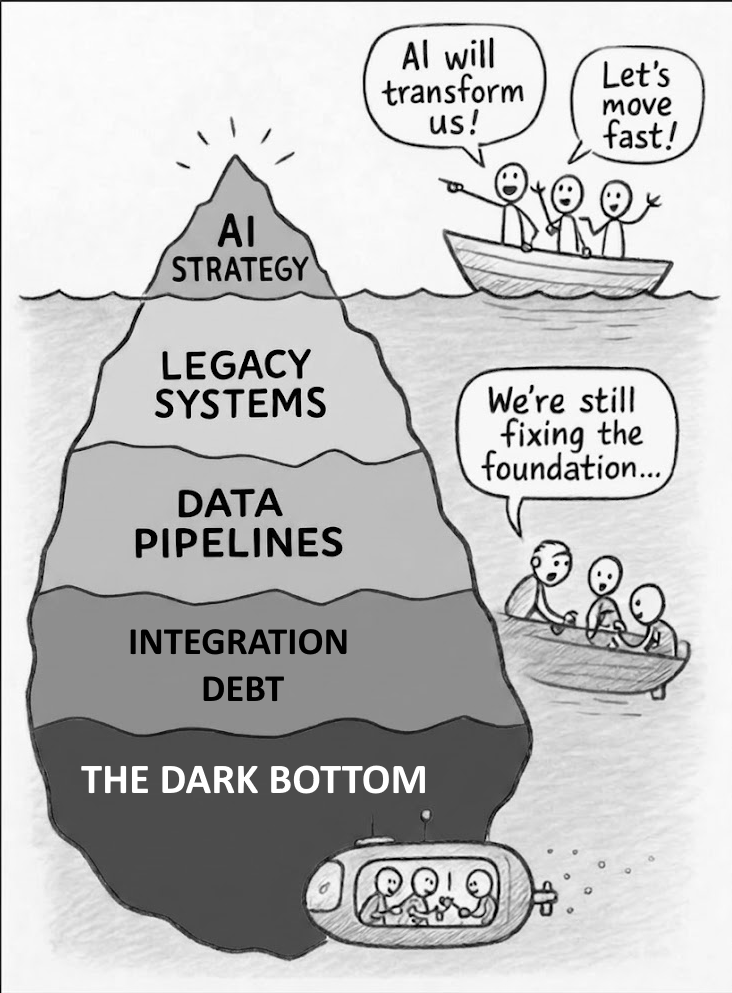
They bought it, they paid for it. The demo was a sheer jubilation. Six months later there is still no return on it. Nothing underneath the waterline changed — the same operating model, the same ownership gaps, the same manual workarounds are still doing the actual work.
But wait, there is a little second boat and also that submarine. In there there are crews of Engineers. They know exactly what’s under the water, because they live down there: legacy systems nobody dares touch, data pipelines patched one incident at a time, integration debt nobody put on a slide. They are not asking for AI.
All crews are suffering the same “debt-berg”. One doesn’t know it yet.
Very small number of companies ever had a real operating model and actually followed it. That used to be survivable — the water stayed calm enough. AI came over the horizon and ended the calm waters. It doesn’t ask for a permission before it hits every domain at once, and it will not tolerate an organization that doesn’t know who owns what, why and since when.
What was optional once is now a precondition to survive.
DBJ Method exists for all: not as a instant rescue, and not as yet another another layer in that iceberg. DBJ crew dives down, maps what’s actually holding the organization up, and gears up the operating model to a state where an AI investment has something solid to stand on. You know the other side: no solid ground, no ROI, no matter how good the demo was. That is not a free fix, instant remedy. DBJ “divers” message to the business is:
1/3 is Engineering. 1/3 is Business and 1/3 is Products. 2/3 is a risk. And that 2/3 is not Engineering.
You do not need a full-time “AI specialist”. You need the CTO-level, decisions made, Enterprise Architect. The one who has the authority to decide what to build, buy, fix, stop or simplify. Someone with the standing to challenge you with the risk without stalling the delivery.
What DBJ Method “installs” is not a person, it is a discipline. It gives Business, Product and Technology groups, a reason for decoupled existence and a shared operating loop. And gives architecture the role to say no, before AI spend meets an organization with no solid ground to land on.
Software product that lasts is a product line to keep, not a project to close. And its time to hand the architecture function real authority: the power to pause delivery, draw boundaries, and question the loudest voices in the business with: “WHY, WHAT and HOW”. For DBJ crew, a month with no visible output is not a popular slide at the board meeting.
First part of engagement there is no happy CEO version of DBJ Method. CEO happiness is a result of a commitment and discipline to keep the operating model running. Once the AI floodgates are opened, and the pressure to ship is allowed to rush-in.
The business commitment is the actual admission fee.